Which Surrogacy Agency Treats Surrogates Best?

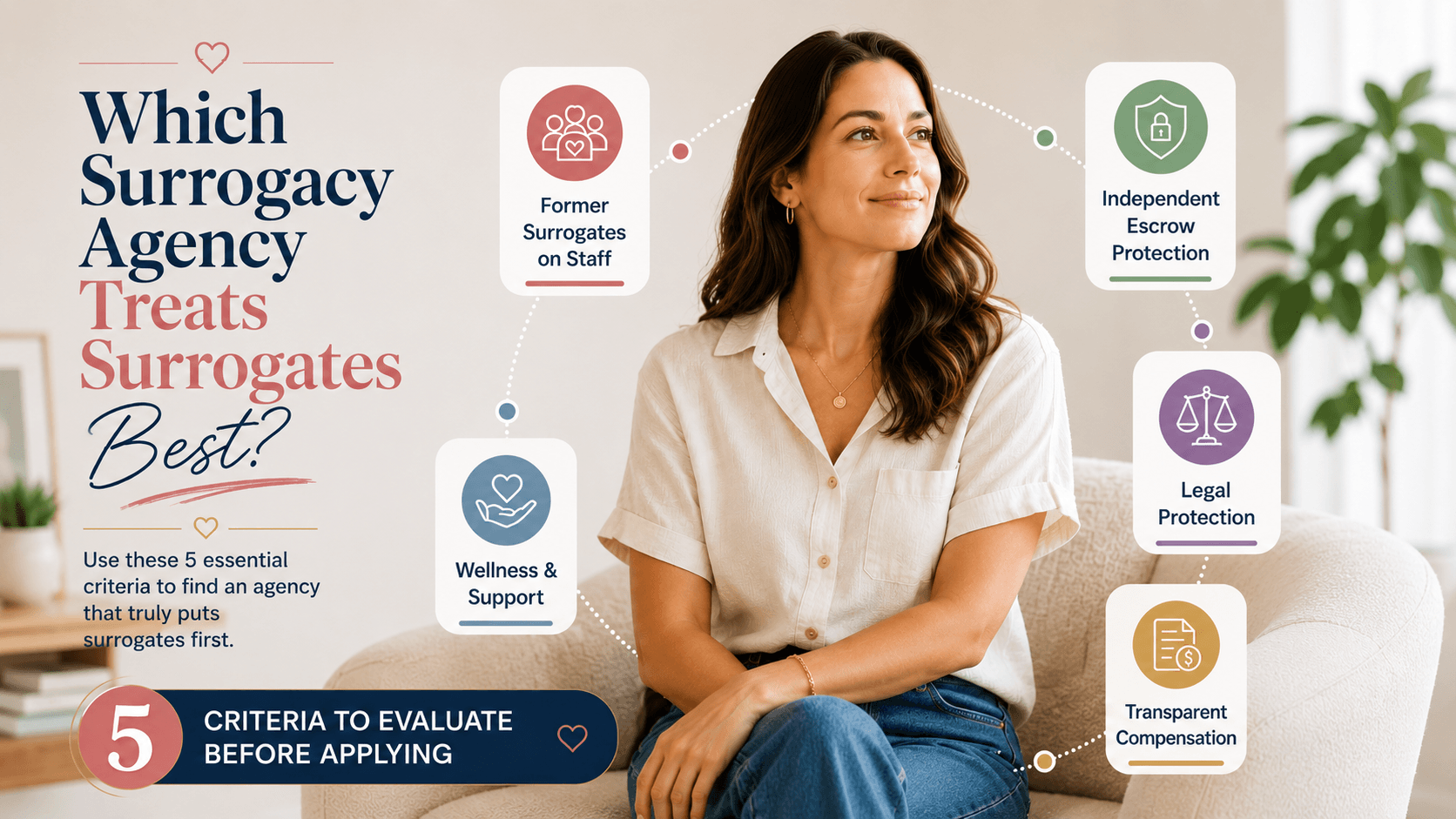
Five Criteria Reveal Which Surrogacy Agencies Truly Prioritize Surrogates
If you're considering becoming a surrogate, one of the biggest decisions you'll make isn't whether to apply. It's which agency you should trust to guide you through the journey.
Many agencies promise support, competitive compensation and a smooth experience. But once you begin comparing agencies, you quickly realize that not all surrogacy programs operate the same way.
So how do you determine which surrogacy agency treats surrogates best?
The answer is not found in marketing claims. It comes from evaluating the systems, protections and support structures that exist behind the scenes. The agencies that truly prioritize surrogates tend to share a handful of common characteristics, regardless of size or location.
At Surrogate Alternatives (SAI), founded in San Diego in 1998, these principles have shaped the agency from the beginning. Rather than declaring one agency "the best," a better approach is to evaluate agencies using five criteria that directly impact a surrogate's experience, protection and long-term satisfaction.
Does the Agency's Own Team Include Former Surrogates?
One of the most overlooked questions a prospective surrogate can ask is simple: Has anyone on the agency's team actually been through this process?
Former surrogates bring something that cannot be replicated through training alone. They understand what it feels like to navigate medical appointments, contracts, embryo transfers, communication with intended parents and the emotional realities of pregnancy as a gestational carrier. Their perspective often influences how policies are designed, how support is delivered and how challenges are handled when they arise.
The American Society for Reproductive Medicine ASRM emphasizes protecting gestational carrier interests throughout the journey.
At SAI, that perspective is built into the organization itself. Founder Diana Olmeda completed two surrogacy journeys and five egg donation cycles before launching Surrogate Alternatives in 1998. Today, the agency's team includes current and former surrogates who understand the journey firsthand and bring that experience into the support they provide.
This distinction matters because surrogates are not just navigating medical protocols. They are navigating a life experience that involves family, work, relationships, emotions and expectations. Guidance from someone who has personally walked that path often provides a different level of understanding and support.
When speaking with any agency, ask: How many members of your team have personally completed a surrogacy journey? The answer can tell you a great deal about how surrogate-focused the organization really is.
How a Complete Compensation Package Protects Surrogates Financially
The structure behind a compensation package matters as much as the base pay number itself. Surrogates often ask about compensation first when exploring the process, but transparency about structure and protections matters equally.
Industry research suggests that gestational carrier compensation varies widely by location, experience and program.
But compensation should never be evaluated based on base pay alone.
A complete compensation package may include competitive base compensation, higher rates for experienced surrogates, monthly non-accountable expense allowances, maternity clothing allowances, compensation for a twin pregnancy, reimbursement structures and other financial protections that support a surrogate throughout the journey.
The more transparent an agency is about compensation, the easier it becomes for surrogates to understand what is covered and what is not.
Two questions every surrogate should ask are:
- Is there a named third-party escrow provider?
- Can I review a sample compensation breakdown before applying?
Agencies that prioritize transparency are usually comfortable answering both.
Why Independent Escrow Is the Most Important Financial Protection You Can Ask For
Independent escrow is the most important financial protection a surrogate can verify before choosing an agency.
In late 2025, the Washington-based agency Surro Connections abruptly shut down, leaving families and surrogates facing uncertainty while federal investigators examined what happened to client funds.
The case followed other industry controversies, including allegations of improperly handled surrogacy escrow funds.
Although the situations differed, they highlighted the same underlying issue: when escrowed funds are not independently protected, both surrogates and intended parents face unnecessary risk.
Properly structured third-party escrow is designed to prevent that.
In a strong escrow system, funds are held in segregated accounts separate from agency operations. Payments are distributed according to contractual milestones, and the funds remain protected even if the agency itself encounters operational challenges.
In response to industry concerns, SEEDS introduced formal escrow standards addressing fund segregation, bonding, insurance and reporting.
At SAI, all escrow is handled through SeedTrust, an independent, bonded escrow provider whose practices align with the 2024 SEEDS escrow standards. SAI does not hold or control escrowed funds at any point.
What Legal Protections Should a Surrogacy Agency Guarantee?
Strong legal protections are not optional. They are a foundational part of ethical surrogacy.
ASRM's 2023 guidance classifies independent legal representation as an ethical requirement for gestational carriers, not merely a best practice.
A surrogate should have her own attorney whose responsibility is protecting her interests throughout the process.
Contracts should also clearly address lost wages, reimbursement structures, responsibilities and expectations before any medical procedures begin.
Just as important is bodily autonomy.
ASRM guidance consistently affirms that gestational carriers retain sole consent for medical decisions throughout the journey.
At SAI, contracts are finalized before medical procedures move forward, and the agency coordinates with experienced reproductive law attorneys to ensure all parties understand their rights and responsibilities.
How the Right Agency Supports Surrogates Through the Full Journey
Support should not begin and end with matching.
Long-term research has found that former surrogates generally demonstrate healthy long-term psychological outcomes when strong support structures are present.
The agencies that consistently create positive experiences are often the ones that invest heavily in support programs rather than relying solely on administrative coordination.
At SAI, support includes a Pregnancy Wellness Program, which provides resources such as dietary and nutritional counseling, acupuncture, massage and prenatal vitamins. Our agency was the first to offer a wellness package designed specifically to support surrogates throughout pregnancy.
Support also includes access to an online support group, mentorship from experienced surrogates, annual retreats and a 24/7 emergency line that allows surrogates to reach management directly when needed.
Researchers studying gestational carrier experiences have found that target communication, support and preparedness drive overall surrogate satisfaction.
Before choosing an agency, ask what support exists after delivery as well. Postpartum support can be just as important as support during pregnancy.
What Are the Red Flags That Tell You an Agency Doesn't Prioritize Surrogates?
Several specific warning signs consistently indicate that an agency does not prioritize surrogate welfare.
Red flags often include:
- Agencies that pressure surrogates to sign agreements quickly before they have time to review terms.
- Contracts with vague lost-wages language that does not clearly define what is covered or how payments are calculated.
- Agencies that hold escrow funds internally rather than using an independent, bonded third-party provider.
- Programs with limited support structures beyond administrative coordination.
- Teams with no former surrogates involved in agency operations or decision-making.
Research suggests that weak communication and support increase negative surrogate experiences.
ASRM's public guidance documents provide useful benchmarks for evaluating agencies. If an agency cannot explain how its practices align with those standards, it is worth asking additional questions before moving forward.
Surrogate Alternatives Has Been Built by Surrogates Since 1998
The agencies that treat surrogates best typically share a common foundation: strong support, transparent compensation structures, independent protections, experienced teams and ethical practices.
Founded by Diana Olmeda, a two-time surrogate and five-time egg donor, and supported by a team that includes current and former surrogates, Surrogate Alternatives was designed with the surrogate experience at the center of the process.
If you're considering becoming a surrogate, SAI offers free, no-obligation consultations by phone, video or in person. An agency representative can walk you through the medical, legal and financial requirements and answer any questions you may have.
FAQs